Commercial Floor Sanding in Chelsea, SW3
Commercial floor sanding in Chelsea, SW3 is rarely just a matter of taking a machine across tired timber and applying another coat of lacquer. In offices, boutiques, restaurants, hotels, clinics, schools and public buildings, we are usually dealing with worn-through seals, ingrained traffic lanes, chair and trolley damage, loose parquet, contaminated finishes and floors that have become difficult to clean properly.
Across Chelsea we work on everything from Victorian conversions and period mansion blocks to King’s Road retail units, Sloane Square offices, hospitality premises and older institutional buildings. Some floors need complete Commercial Floor Restoration in Chelsea; others are sound enough for controlled sanding, local repairs and a planned Commercial Floor maintenance in Chelsea programme rather than unnecessary heavy restoration.
If the timber and existing coating are still serviceable, professional Commercial Floor Polishing in Chelsea can sometimes recover appearance and extend the coating cycle without sanding back to bare wood. The correct treatment depends on the timber species, previous finish, wear depth, moisture condition and how quickly the premises must return to service.
Commercial Timber Floors in Chelsea Take Different Punishment
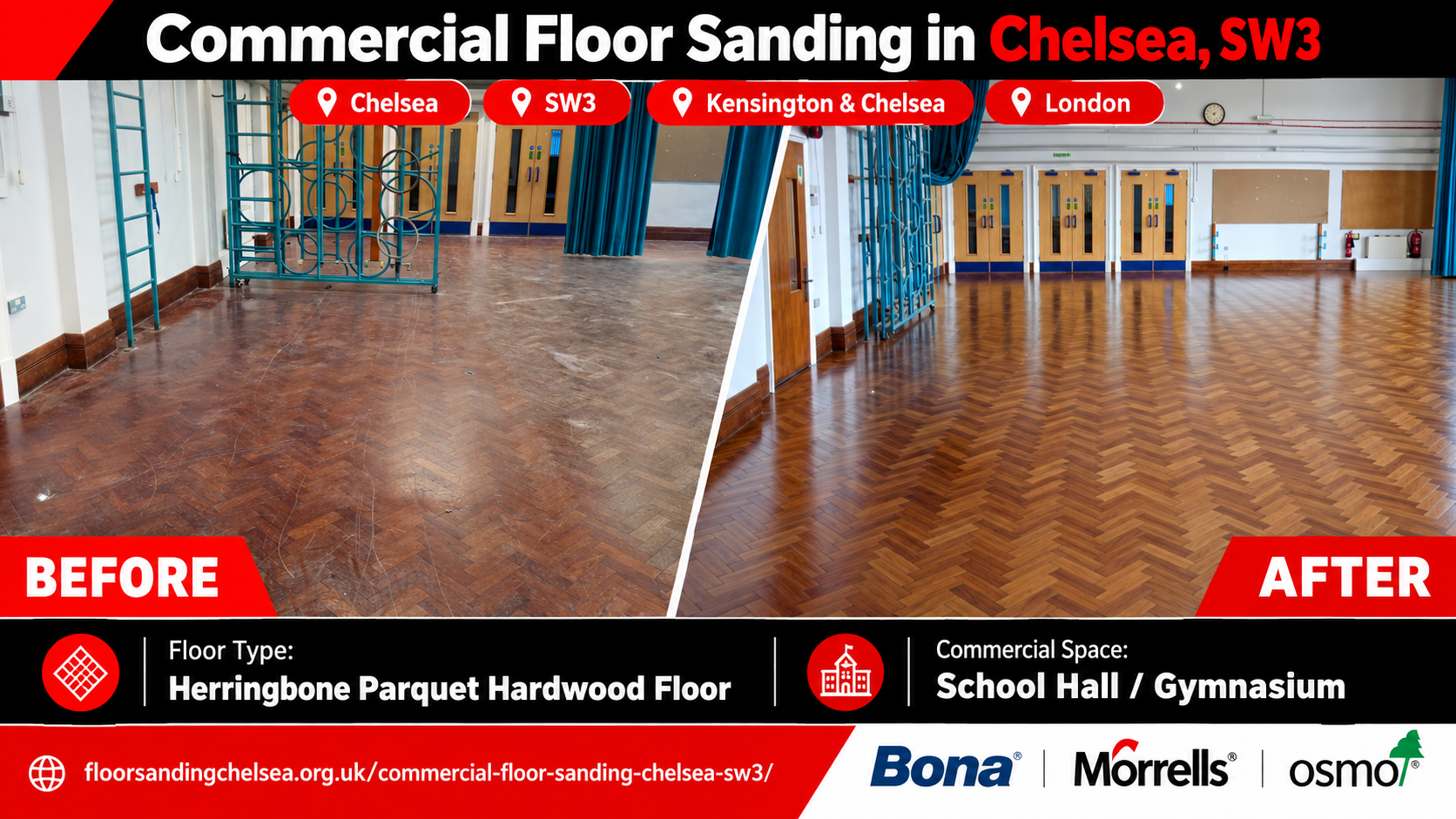
A shop near King’s Road may take thousands of grit-loaded footsteps across its entrance zone. A restaurant floor deals with grease, cleaning chemicals, spills and furniture movement, while a serviced office sees concentrated wear from castor chairs, reception traffic and wheeled equipment.
That is why domestic sanding specifications and supermarket floor polish are generally poor solutions for heavily used commercial timber. A finish chosen because it looks acceptable on day one can soften under chemical cleaners, mark beneath rubber feet or become dangerously smooth when contaminated with water or grease.
Chelsea also has a high concentration of older properties and protected streetscapes. Around Sloane Square, the Royal Hospital area, Cheyne Walk and the streets running between Fulham Road and King’s Road, we regularly encounter floors installed into buildings where previous alterations, old bitumen residues, mixed timber repairs and uneven subfloors require careful investigation before machinery is started.
- Open board gaps: trap grit, food debris and cleaning moisture, particularly in cafés, pubs, schools and hospitality premises.
- Loose parquet blocks: can move under point loading and eventually fracture tongues, edges or neighbouring blocks.
- Worn entrance zones: allow water and abrasive grit directly into exposed timber fibres once the protective film has failed.
- Moisture ingress: can cause cupping, edge lift, adhesive failure and dimensional movement that sanding alone will not correct.
- Incorrect slip characteristics: require particular attention in reception areas, hospitality spaces, clinics, schools and other public-access premises.
- Old cleaning residues: including wax, silicone and detergent films can interfere with coating adhesion unless removed correctly.
- Mixed timber repairs: need matching by species, grain and movement characteristics rather than simply fitting whichever board is closest in colour.
Our Commercial Floor Sanding and Restoration Process
Step 1: Subfloor Audit & Moisture Testing
Before pricing a substantial commercial floor properly, we establish what is actually underneath the wear. Timber identification matters: quartersawn oak behaves differently from old pitch pine, teak, maple or engineered flooring, and each responds differently to abrasives, stains, fillers and finishes.
We inspect for loose boards, hollow parquet, deflection, damaged tongues, old adhesive beds, metal fixings and previous sanding depth. Hygrometer checks and appropriate moisture readings are taken where there is any concern about screed moisture, recent leaks, basement conditions or timber movement.
There is little sense putting an expensive two-component coating over a floor that is still moving because of moisture below it. Where readings are questionable, the cause is dealt with before restoration progresses rather than sanding away evidence of the underlying problem.
Step 2: Timber Repairs, Re-bonding & Resin Gap-Filling
Repairs are completed before fine sanding so the repaired material finishes into the surrounding floor rather than sitting proud afterwards. Salvageable original boards are retained where practical, particularly on older Chelsea floors where the colour and growth pattern of seasoned pitch pine or oak are difficult to replicate with new stock.
Loose parquet blocks may be lifted, cleaned and re-bonded using a suitable silane-based flexible parquet adhesive rather than relying on brittle patch repairs. Silane systems are useful where a degree of elasticity is required and low-emission EC1 Plus-rated products can be specified where indoor air quality is a particular concern.
Fine stable gaps can be treated with resin-slurry filling produced from clean sanding dust and a compatible floor resin. Larger or mobile gaps may require timber slivers, individual repairs or a flexible system instead; forcing hard resin into a moving 6 mm board gap usually results in cracking later.
Step 3: HEPA Dust-Controlled Sanding & Surface Preparation
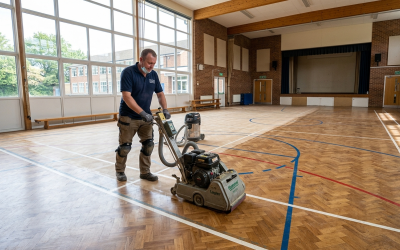
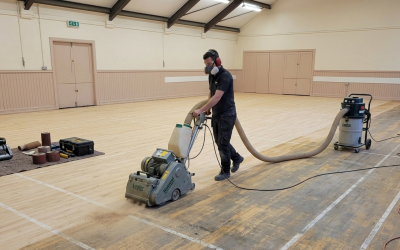
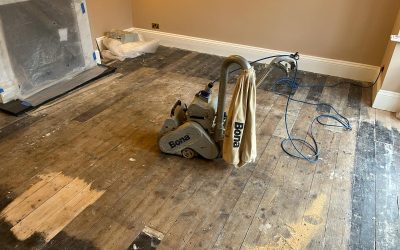
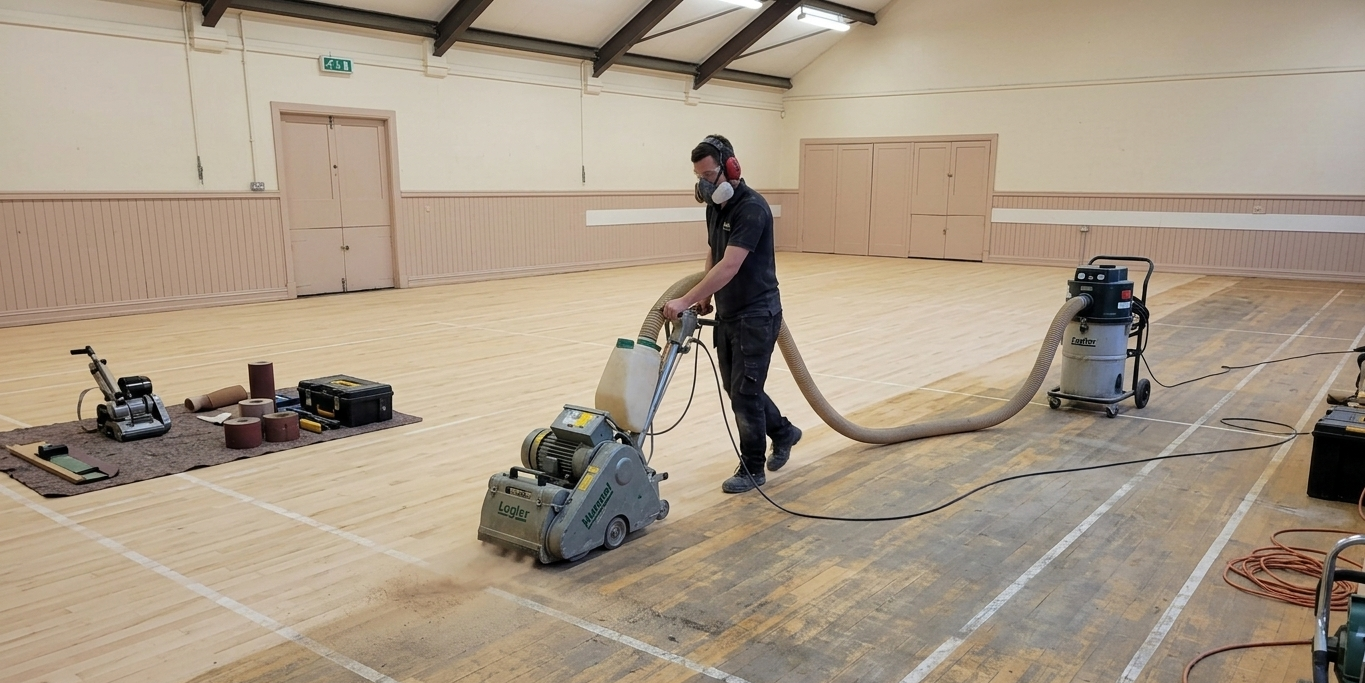
For heavy commercial stripping we use professional belt sanding equipment such as the Lägler Hummel rather than lightweight hire-shop machinery. Progressive abrasive grades remove failed lacquer, scratches and contamination while keeping unnecessary timber removal to a minimum.
Edge sanding, detail sanding and intermediate finishing are carried out as separate operations. The final abrasive sequence is selected according to the timber and coating system because sanding too coarse can leave visible tracks, while over-polishing the timber can reduce stain uptake and affect adhesion.
Machinery is coupled to high-efficiency extraction, with HEPA H14 filtration used where the site specification calls for enhanced fine-dust control. No sanding process is literally dust-free, but correctly maintained extraction makes a major difference on active offices, shops, healthcare premises and education sites where dust migration has to be controlled.
Doorways, lifts, corridors, fire routes, alarms and adjacent occupied areas are considered in the RAMS before work starts. Extraction does not replace isolation and housekeeping; the two have to work together on a properly managed commercial site.
Step 4: High-Traffic Finishes – 2K Lacquers, Hardwax Oils & Anti-Slip Systems
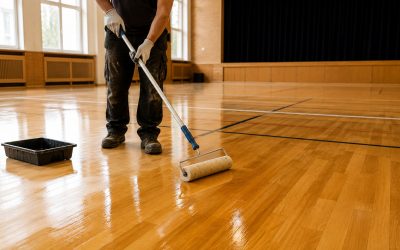
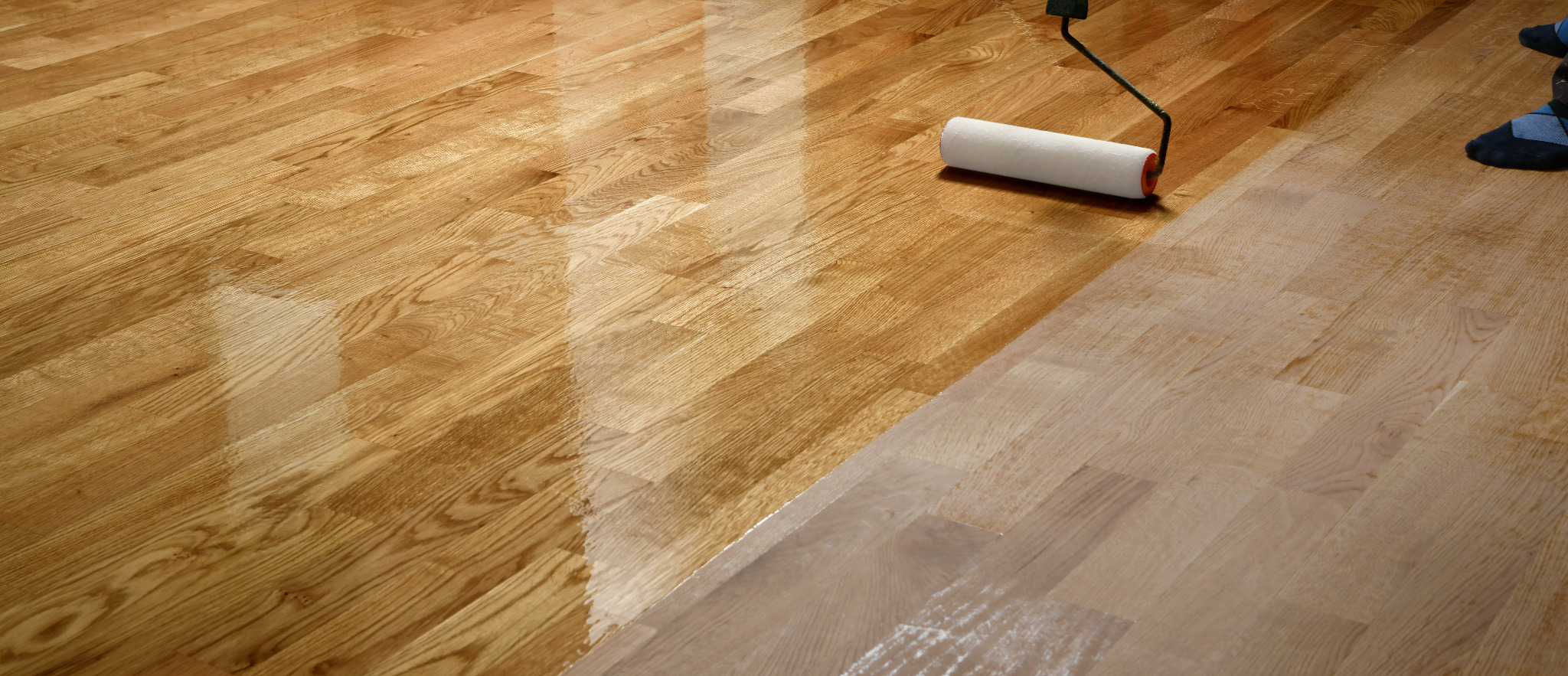
The finish is specified for the use of the building rather than chosen from a colour chart alone. For demanding offices, retail premises, corridors and hospitality floors, we commonly favour professional 2K waterborne polyurethane systems where the hardener or cross-linking catalyst produces substantially greater chemical and abrasion resistance than a basic single-pack domestic lacquer.
Where repairability and a lower-build appearance are preferred, a commercial-grade hardwax oil may be more suitable. It can work particularly well in certain boutiques, heritage interiors, studios and lower-intensity hospitality areas, provided the client understands the maintenance regime.
Entrances, bars, serving areas, clinics and public circulation spaces may require additional slip-resistance consideration. Where formal slip-performance verification is specified, the coating system and completed surface can be assessed using recognised pendulum testing procedures associated with BS 7976-2 requirements and the relevant project safety specification.
Samples are worthwhile on old oak, pitch pine and stained floors because timber density and previous contamination can alter the finished colour. We would rather approve a test area with the client than discover after several hundred square metres that an historic floor absorbs stain differently from a modern sample board.
Step 5: Aftercare & Commercial Floor Maintenance
The first maintenance decision is made before the final coat goes down. We provide guidance on compatible cleaners, entrance matting, furniture protection and periodic machine cleaning so staff do not unknowingly damage a new coating with strong alkaline detergent, steam cleaning or inappropriate polish.
High-traffic commercial floors should be inspected before the sacrificial surface is completely worn through. A timely clean, key and maintenance coat can be considerably less disruptive than waiting until exposed grey timber requires another full sanding cycle.
For examples of repaired, sanded and refinished timber flooring, visit our floor sanding gallery. Budget guidance for sanding, gap filling, lacquer upgrades and associated work is available on our floor sanding prices page, although commercial projects are quoted following an assessment of condition, access and programme.
Commercial Sectors We Work With in Chelsea, SW3
Different premises create different wear patterns, access restrictions and finish requirements. We plan commercial floor restoration around the way the building actually operates rather than attempting to apply one specification to every site.
- Private offices, coworking and serviced offices: reception areas, meeting rooms, open-plan spaces, corridors and executive suites.
- Shops, boutiques and showrooms: entrance wear, display areas, fitting rooms, back-of-house spaces and shopping-centre units.
- Restaurants, cafés, pubs and takeaway units: dining floors, bar areas, customer routes and furniture-heavy spaces.
- Factories and workshops: older timber work floors, offices, studios and light manufacturing spaces where appropriate.
- Storage units, distribution centres and delivery depots: timber-floored ancillary areas, offices and loading-related circulation zones.
- Gyms, cinemas, event venues and studios: large-area timber floors requiring controlled scheduling and durable finishes.
- Hotels, hostels and serviced accommodation: bedrooms, corridors, lounges, reception areas and phased refurbishment floors.
- Clinics, dental practices and treatment rooms: areas where dust control, cleaning compatibility and rapid return to use are important.
- Schools, colleges, universities and academies: classrooms, halls, sports areas, stages, libraries and circulation spaces.
- Churches, mosques and temples: halls, aisles, meeting rooms and large timber floors where work often needs scheduling around services and community use.
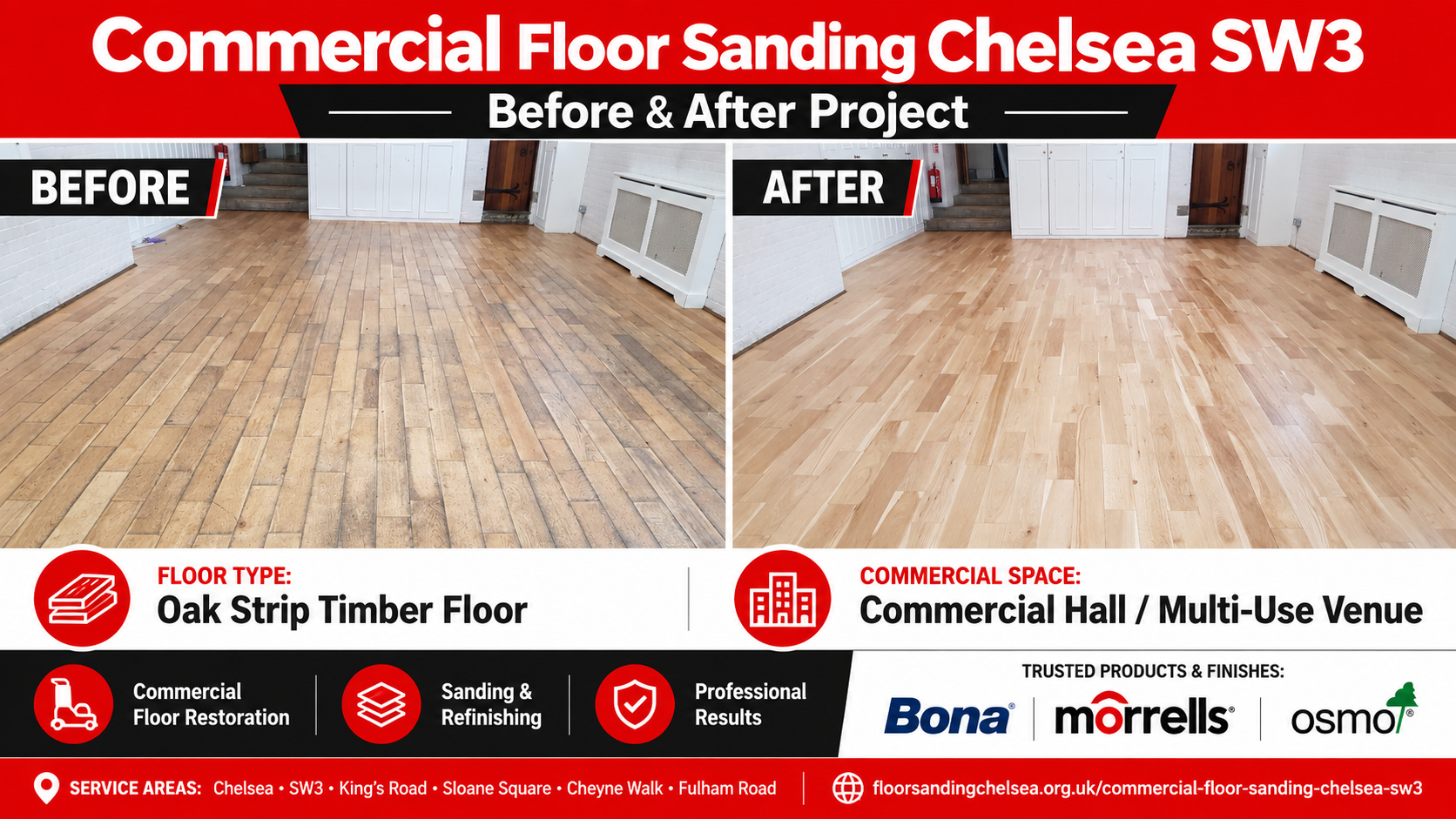
Out-of-Hours Floor Sanding Without Closing the Whole Premises
Commercial work is often less about how quickly a sanding machine can remove lacquer and more about sequencing. A technically perfect floor is no use to a restaurant if tables cannot go back for service, or to an office manager if a newly coated fire route cuts staff off from half the building.
We can programme work around evening closure, weekends, school holidays or phased access. The programme takes account of sanding noise, dust containment, coating intervals and the point at which the finish is sufficiently cured for light foot traffic, furniture and full commercial use.
| Working Arrangement | Operational Benefit | Typical Facility Suitability |
|---|---|---|
| Overnight | Heavy sanding and coating can be completed outside customer or staff hours, subject to finish cure times and noise restrictions. | Shops, boutiques, offices, restaurants, cafés, clinics and showrooms. |
| Weekend Phased | Larger areas can be divided into planned work zones, allowing controlled reopening between phases where the coating programme permits. | Serviced offices, schools, hotels, coworking spaces, clinics and institutional buildings. |
| Sectional | Keeps part of a large premises operational while furniture, equipment and access routes are transferred between completed sections. | Hotels, event venues, education sites, offices, studios, places of worship and large retail premises. |
Cure Times, Reopening and Furniture Replacement
Dry to touch is not the same as ready for commercial traffic. Waterborne 2K lacquer may accept careful light foot traffic relatively quickly, but full cross-linking and chemical resistance develop over a longer period and vary according to the manufacturer, temperature, humidity, ventilation and coat thickness.
We set reopening times against the product technical data rather than making a blanket promise that every floor can be used the following morning. Heavy furniture, rubber-backed mats, rolling loads and wet cleaning may have to remain off the surface longer than ordinary sock or light shoe traffic.
Where downtime is critical, that constraint needs to be discussed at survey stage. It allows us to select a suitable coating and divide the work intelligently instead of compromising the curing process after the floor has already been coated.
RAMS, COSHH and Commercial Site Safety
Commercial sanding produces risks that have to be controlled properly: machinery movement, electrical equipment, fine timber dust, noise, coatings, restricted access and freshly finished surfaces. For managed sites we prepare appropriate RAMS documentation and assess coating, filler, adhesive and cleaning products under COSHH requirements.
Pedestrian routes, emergency exits and occupied areas are agreed before work begins. On multi-trade refurbishments we also coordinate access with decorators, electricians, joiners, furniture installers and principal contractors because allowing other trades across an uncured floor is one of the quickest ways to spoil a finished job.
Where a specification calls for low-emission materials, suitable EC1 Plus-rated adhesives and compatible low-VOC coating systems can be considered. Product selection still has to account for bond strength, substrate condition, timber movement and service loading; an emissions rating alone does not make a product fit-for-purpose.
Why Chelsea Commercial Floors Need Proper Surveying
Chelsea has an unusual mixture of high-footfall retail streets and older buildings. Around King’s Road and Sloane Square, commercial units often sit within or alongside period structures, while quieter streets contain late-Georgian, Victorian and Edwardian properties converted over many decades for offices, hospitality, healthcare and other uses.
That history often shows in the floor. We find mixed board widths, former hearth openings, partitions removed years ago, old service penetrations, parquet patches, bitumen adhesive and areas that have already been sanded several times.
Conservation-area status does not automatically make an internal timber floor untouchable, but older fabric still deserves a repair-first approach. In a mature oak parquet or pitch-pine floor, retaining serviceable original material usually produces a more convincing result than stripping everything out simply because replacement appears quicker.
Commercial Floor Sanding Quotes in Chelsea
A useful commercial quote needs more than a square-metre figure. We consider floor type, current coating, repair quantity, access, furniture, electrical supply, working hours, dust-control requirements, finishing specification and the number of separate mobilisation phases.
An initial assessment can normally begin from clear photographs or video showing the full floor, entrance areas, damaged sections and representative close-ups. Floor plans are particularly useful for offices, schools, hotels and multi-room commercial premises because they allow us to discuss phasing before arranging the physical site survey.
For contractor-managed sites, CSCS-carded operatives can be allocated where site rules require them, together with relevant RAMS and insurance documentation before mobilisation. Commercial liability cover and the working specification can be confirmed during the quotation process so facilities managers and principal contractors know what is being allowed for before the programme is agreed.
A Practical Specification, Not an Automatic Full Sand
We do not assume that every marked commercial floor needs to be stripped to bare timber. If the existing finish still has sufficient film build and adhesion, a deep clean, mechanical key and compatible maintenance coating may preserve timber thickness and reduce closure time.
Conversely, putting another polish over a floor with exposed fibres, failing lacquer, silicone contamination or loose parquet simply hides the defect for a short period. The survey establishes which level of intervention is justified and where localised repairs can avoid unnecessary work elsewhere.

Arrange a Commercial Floor Survey in Chelsea, SW3
If you are responsible for an office, shop, restaurant, hotel, school, clinic, venue or other commercial building in Chelsea, call 0800 335 7565 to discuss the floor, access restrictions and required completion date.
You can also send site photographs, video and floor plans by WhatsApp or email for an initial assessment. For larger or technically uncertain floors, we will then arrange a physical survey so repairs, sanding stages, finish specification, phasing and cure times can be priced properly.